How to Improve Your Blog: The Complete Strategy Guide for Traffic, Quality, and Growth
how to improve your blog? Many bloggers put in a lot of effort and find themselves stuck. They consistently publish, follow guidelines from YouTube instructions, then see their traffic gauge barely move. The issue isn’t the effort’s the how they do it. Enhancing your blog’s performance isn’t simply about implementing more features. It’s about implementing the right actions in the proper sequence, based on what your blog’s specific requires.
The fastest method for improving your website is to review your existing content prior to making any new content. Make sure that you address any issues with performance and strengthen weakest posts, develop a clustering strategy for content that is centered around your subject and then optimize your blog for E-E A-T signals that gain Google’s confidence. The four steps above, when executed in a sequence, will always beat creating more content that has no basis for strategic planning.
What “Improving Your Blog” Actually Means in 2026
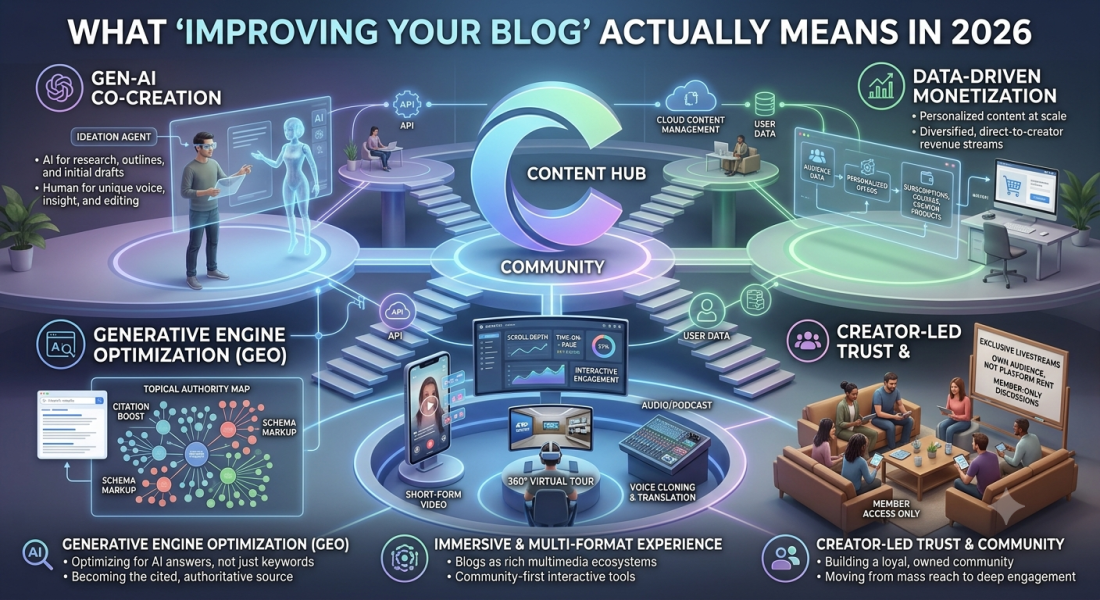
Improvement of your blog used to mean posting more content, selecting more appealing images, and sometimes changing your theme. The time for improvement is now over.
In 2026, enhancing your blog’s performance will help you gain organic exposure in a intensely competitive content market which is created with the Google’s Helpful Content Update, AI-generated search overviews, and a population that is scattered across a myriad of different platforms. The standard of “good sufficient” has increased substantially.
What Google offers now is evidence of competence, real-time utility as well as a cohesive editorial identity. A blog that functions as an unorganized collection of posts that cover a broad range of topics will be unable to compete. A blog that explores a specific area with a clear, deep and credibility will expand.
It’s not about playing with algorithms. It’s about creating something that is worthy of taking a look at.
The Four Pillars of Blog Improvement: Content, SEO, UX, and Authority
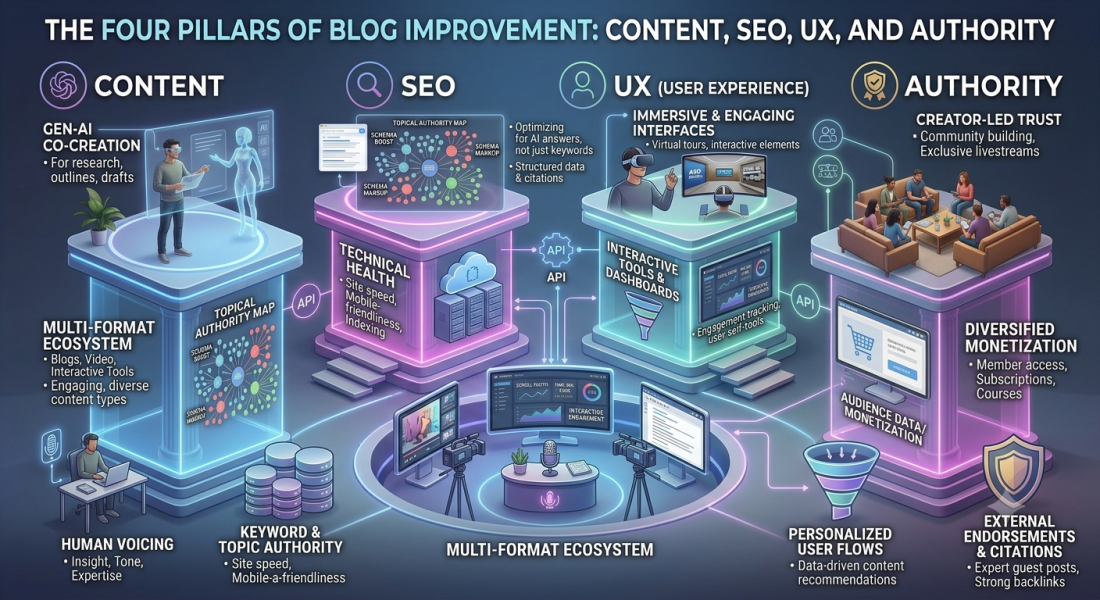
Each element on how to improve your blog is mapped to one of the four interconnected four pillars.
Quality of content is the base. This is based on how your content answers questions from readers as well as how clear you write, how your content is organized, and whether you have an actual knowledge of the subject issue. Content written solely to get a keyword’s attention without providing any real insight is currently being penalized.
SEO’s fundamentals are the layer of distribution. Even the most compelling content can be ignored without the basic optimization of your page such as title tags Meta descriptions, keywords location, heading structure internal links and schema marksup. These aren’t tricks; they’re signals to help search engines comprehend and classify what you’ve written.
UX (UX) determines whether users stay for longer after they have arrived. Speed of page loading, responsiveness on mobile clear typography, an logical structure for the post and a well-designed layout all affect bounce rate and dwell time as well as the probability of a person returning. A page that loads in less than four seconds on mobile will lose the majority of its viewers prior to the first paragraph.
Topical authority is the game that lasts for a long time. It’s how search engines judge the depth of your website’s knowledge within a particular subject. To establish authority, you must implement a comprehensive strategy for content that is not limited to specific posts. It’s about creating a series of interconnected content which indicate extensive coverage of an of study.
Why Most Blog Improvement Advice Fails — and What to Do Instead
Common blog advice is useless because it assumes that all blogs are suffering from the same issues. “Write more lengthy posts” is a useless suggestion for blogs whose posts have already been written in a 2,000 word range but do not have internal linking. “Post more often” does nothing to help the blogger whose current content is prone to technical errors.
The answer is diagnosis prior to prescribing. Before you implement any improvement plan it is important to determine the specific issue. Are you experiencing issues with traffic (people aren’t able to locate you) or engagement (people arrive, but leave quickly) or conversion (people are reading but don’t subscribe or purchase) or authority (Google does not rank you in low-competition searches)? Each issue has a unique solution.
Step 1: Audit Your Existing Blog Before Adding Anything New
The most infrequent blogging improvement method is the content audit. Many bloggers rush to publish new content, while their current library is slipping in performance, impacting the overall website’s credibility and waste the time and effort they already put into.
An audit will tell you which content needs to be updated or consolidation and removed or redirected and the rest are best left to be ignored because they’re already performing.
Realated Guide: How to do blogging in india
How to Run a Content Audit on Your Blog
Begin by exporting each publicly-available URL on your site. In WordPress it is possible to do this using The All Export plugin or through Google Search Console’s coverage report. With Google Search Console, pull the data for every URL’s impressions and clicks average position, as well as the rate of click-throughs for the last 12 months.
Open Google Analytics 4 and layer in the behavioral data: sessions per post and average engagement time and scroll depth, if you’ve configured that. The two datasets can be cross-referenced to group each blog post in one of the four buckets.
Bucket 1 Protect and improve: These posts already get good rankings and drive traffic. Do not alter the URL or structure. Incorporate internal links from more recent articles that link to them, update any old stats or illustrations, and make sure the formatting is neat.
Bucket 2 — Refresh to optimize This post has decent views (people are finding them through search results) however they have a low CTR or a low engagement rate. The content could be out of date and the title might be poor, or the article might be lacking in depth compared to other results. They are rewritten according to a plan.
Bucket 3 Combine or redirect The posts are prone to very little or no impact and cover a few duplicate topics, and will perform better when consolidated into a more extensive piece. If you consolidate, make 301 redirects from the previous URL into the newly post.
Bucket 4,Delete: Posts with zero impressions, no backlinks poor quality, and little strategic significance. Removal of content that is actively signaling poor quality to Google can boost the overall quality signals from your domain.
Identifying Your Top and Bottom Performers
Once you’ve categorize your content, you can sort them according to a performance score, which includes the number of visitors, rank position and the amount of engagement. The top performers will reveal the needs of your readers in addition to what Google already believes you can write about. Explore those topics by incorporating subsequent posts, updated versions and clusters of related content.
Your lowest performers can be an instrument for diagnosing. Find patterns: Are they weak posts from a specific time frame that you weren’t as experienced? Are they on subjects that are not related to your primary field? Do they use a style of formatting that isn’t in line with the way you write? This pattern is often indicative of the strategic error that, when fixed, will clear the way to more consistent growth.
Step 2: Fix Your Technical Foundation
Before you write another word of new content Your blog’s technical health requires a thorough examination. Problems with your website’s technical health can cause rankings to disappear and don’t reveal their presence the way a poorly written blog post would.
Core Web Vitals: The Performance Benchmarks That Affect Rankings
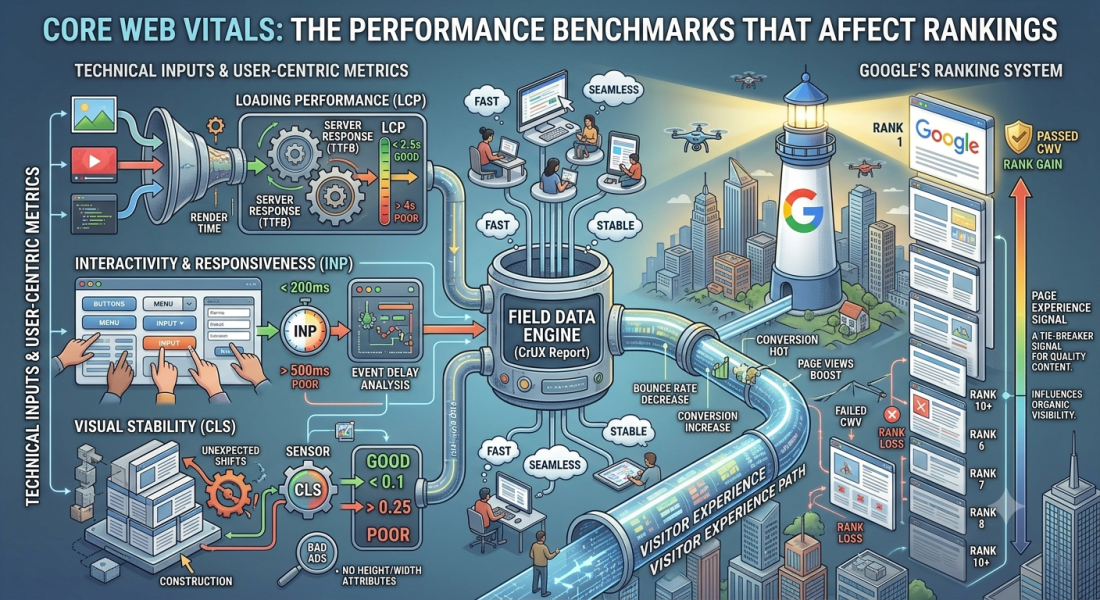
Google’s Core Web Vitals measure three things the largest amount of contentful Paint (LCP) which should be less than 2.5 seconds and Interaction to the Next Paint (INP) which must be less than 200 milliseconds. Cumulative Layout Shift (CLS) that should be below 0.1.
Test your blog using Google PageSpeed Insights and Google Search Console’s Core Web Vitals report. If you’re running WordPress and you’re using the WordPress plugin, the primary causes of failure scores are images that are not optimized as well as excessive plugins and hosting and rendering-blocking JavaScript. Installing a light caching plugin (WP Rocket or Total Cache from W3) and compressing images into WebP format and changing to a more efficient managed hosting option will solve the majority of these issues without altering your content.
Mobile performance is more important than desktop performance. The majority of the organic search traffic is generated on mobile devices and Google utilizes mobile-first indexing. In the event that your website is not responsive, or the fonts decrease below 16px on mobile devices and readers aren’t getting the message before they’ve even read a word.
Fixing Crawl and Index Issues
Start Google Search Console and check the Pages report under Indexing. URLs that say “Crawled and currently not being indexed” refer to websites Google has visited, but determined they aren’t worthy of indexing. This could indicate weak material, redundant content or the possibility of cannibalization between articles on the same subject.
Verify for canonical tag issues and broken internal links and pages that are orphaned (pages that have no internal links that point towards them). Screaming Frog’s free crawler can trace your entire site’s structure and identify issues in just a few minutes.
Step 3: Strengthen Your Content Quality
After technical issues are addressed Once technical issues are resolved, content quality is the most leveraged improvement area. This isn’t just about words count, but about real value.
Writing for E-E-A-T: What It Actually Looks Like in Practice
E-E A-T stands for Experience Expertise and Authoritativeness. Trustworthiness. These are the indicators that Google’s Quality Raters employ when looking at content, and they’re increasingly incorporated into the algorithm itself evaluates content.
Experience implies that you’ve actually done the task that you’re writing about. A blog post on building an elevated garden bed written by someone who constructed one is different than a piece of content compiled from other pieces of content. First-person experiences, precise measures, real failures and authentic recommendations provide evidence that generic content can’t duplicate.
Expertise is the ability to demonstrate mastery of the subject. It’s not necessary to have academic credentials However, you need to demonstrate that you know the intricacies of the subject, its exceptions, and the context surrounding the subject you’re writing about. The posts that simply rehash the same information without providing an analytical basis will be difficult to get a spot in the rankings.
The credibility of your website is developed over time with constant thorough coverage of your field and also through mentions, hyperlinks and references from other reliable sources.
Credibility is built through the accuracy of information that clearly identifies authors with bios, clear editorial guidelines, and truthful public disclosure of affiliate relations or sponsored content.
How to Write Blog Introductions That Actually Keep People Reading
The introduction to a blog post is what determines if the rest of the blog post gets read. A majority of introductions fail due to the fact that they begin with a generic context setting (“In our digital world of today blogging has evolved into a form of communication …”) instead of immediately asking why the reader came. understanding how to properly do blogging and targeteting a huge audience is also a gap for newies that’s why reading this practical guide on what is blogging and what are its advantages and disavantages will save your precious time before you directly rush and jump
A compelling introduction accomplishes three things in less than 150 words. This proves that the reader is in the correct place, it confirms the issue they’re trying to solve, and then it outlines the value that they’ll get when they continue. Start with the most relevant sentence you can create (not a warm-up sentence is the fastest method to boost the engagement of your existing posts.
Structuring Posts for Both Readers and Featured Snippets
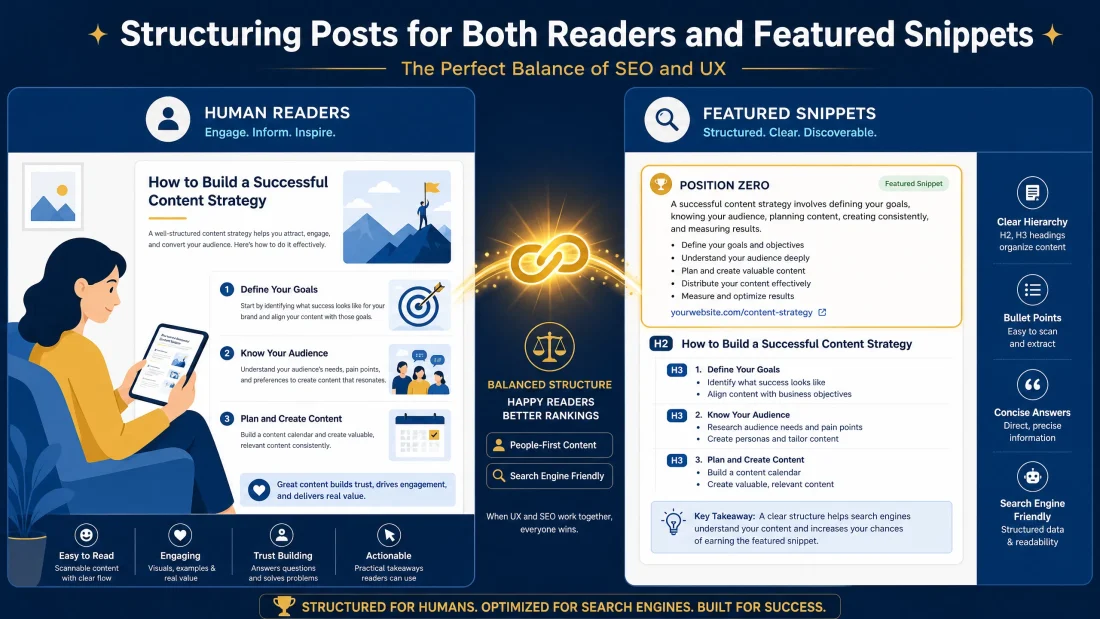
A good structure for a post serves two distinct audiences the human reader who demands logical flow as well as the engine, which requires clear information about what the article is about.
Use H2 headings for the major section topics, with H3 headings used for the sub-points in those sections. Your H2 headings should be full, meaningful sentencesnot slick teasers. Heading text is used by search engines to determine the structure of content and readers look at headings to determine whether they want to take the time to read a particular section.
When you’re targeting snippets from featured posts make sure you answer the question at the heart of your post in a concise, clear paragraph that follows the headline that asks the question. The lists of steps or items should be bulleted or numbered style rather than prose if there are more than four items. Tables are great for comparing and for specifications.
Step 4: Build a Keyword and Content Strategy That Compounds
Random publications don’t establish credibility. A systematic coverage of topics that are interconnected can.
Understanding Topical Authority and Content Clusters
Topical authority refers to the degree to which search engines consider your website as a complete reliable and trustworthy source on specific topics. A blog that has posted thirty articles on fitness nutrition that cover everything from macros to meal times to supplements and hydration will be able to outperform a website with a single post on each of these subtopics as well as content on totally non-related subjects.
Content clusters represent the structure application of authority based on topic. Each cluster is comprised of an one-page pillar page- an extensive overview of a broad topic — as well as an array of posts that discuss specific subtopics in detail. The pillar page provides links to every post supporting it. Every post that supports it connects back to the pillar’s page and to related siblings posts within the cluster.
The internal linking architecture provides precise semantic signalling for engines, and assists in spreading authority across the group.
Keyword Research for Bloggers: Finding Winnable Targets
The purpose of research isn’t to discover the most-popular keywords. It’s about finding keywords for which your site stands the potential to rank due to the authority of your domain and the amount of competition.
Sort your keywords by the combination of search volume and difficulty. For a brand newly-created or mid-sized blog focus on keywords that have scores of less than 40 (using Ahrefs scale or SEMrush scale) and that have informational purpose These are the keywords where useful written, well-structured content is able to compete without requiring a plethora of backlinks.
Take a look at one of the results on page 1 for each search term you’re interested in. If all results are from a major newspaper that has thousands of backlinks, it’s not the best place to start. However, if the results contain personal forums, blogs, and a few pages on smaller sites there’s a chance to win.
The Long-Form Version vs. Short-Form Matching Depth to Intent
The length of a blog post doesn’t have to be three hundred words. The appropriate length is one that can answer the question the searcher is looking for without padding. Some queries for information are answered by 800 words. Other topics require 4,000 words to describe the subject in depth.
Use the results of your search to inform your decision-making. Look through the top three posts for your keyword of choice Estimate their word counts and apply that as a baseline. Ask yourself: What did they not cover? What questions does the reader not have a solution to after reading these articles? This is the place the point where you add value not through length or depth, but rather by bringing information.
Step 5: Master Internal Linking and On-Page Optimization
Internal linking is among the least utilized SEO techniques for bloggers and is among the easiest ones to improve without the need to create new content.
Building an Internal Linking Architecture That Works
Each new blog post you make should include links to at least three or two existing posts in your website. Every blog post that is already popular should be linked to the most recent or related content. The flow of authority on your site is dependent on links, and even orphan pages — those with no internal links linking to them — have no authority, regardless of how well-written the content.
When creating internal links, make sure to make sure the anchor text is descriptive and matches the theme of the page you are linking to. “Click Here” as well as “read further” are a waste of time. “How to conduct an audit of content” is an anchor-text that informs readers as well as search engines precisely what they’ll discover on the way to the destination.
Check your internal links regularly. A blog post that had a high rank two years ago, but was never linked to from more recent content is similar to the room without doors -It is there, and Google is able to detect it, however it doesn’t receive any authority reinforcement from your other website.
Here’s simple way on How to Improve SEO of Your Blog Without Overcomplicating It
On-Page SEO Checklist for Every Blog Post
| Element | Best Practice |
|---|---|
| Title Tag | Include your primary keyword near the top of the page Keep it under 60 characters |
| Meta Description | 150-160 characters; use keywords and write to get clicks, not for indexing |
| H1 | Should be in close alignment with or reflect the tag’s title; only one H1 per post. |
| First 100 Words | Include the keyword that is naturally within the first paragraph |
| Image Alt Text | Text that is descriptive, relevant to keywords on every image |
| Internal Links | Minimum of 3 posts Use descriptive anchor text |
| External Links | Link to authoritative sources in which you reference data or claims |
| URL Slug | Keyword-focused, short, and no stop-words; it corresponds to the topic of the article. |
| Schema Markup | Create schema for Articles at a minimum the FAQ schema to articles with FAQ sections |
| Reading Level | Try to ensure that 6th-8th grade readers are able to read with the Flesch-Kincaid scale. |
Step 6: Build Your Audience, Not Just Your Traffic
Retention without traffic is like a leaking bucket. Any improvement you can achieve to gain new readers will be more beneficial in the event that those readers return.
How to Improve Your Blog Design for Trust and Readability
Converting one-time visitors into subscribers
A list of email addresses is one of the most trustworthy audience asset that a blogger can develop. Contrary to followers on social media or the search engine traffic the email list you have is yours and no algorithm change could be able to take it away from you.
The most effective opt-in email methods for blog posts are embedded within the content, instead of annoying pop-ups that appear upon their arrival. An opt-in option placed midway through a lengthy blog post, and containing a related document — such as an outline, a template or a reading list that is curated is converted at significantly more than a standard “subscribe to my mailing list” banner.
ConvertKit as well as Mailchimp both offer free tiers that are ideal for bloggers who have less than 1,000 subscribers. Start with simple welcome sequences -up to three emails over a period of 2 weeks. This will deliver the promise of your opt-in and introduces new readers to your top content.
Using Comments, Community, and Social Proof to Build Engagement
Signals of high engagement like shares, comments returns visits, comments are all valuable and can be important as indirect SEO signals via more brand-named searches and direct traffic.
Be sure to respond to every comment made to your blog particularly during the first few months of your blog. This lets readers know that there’s a person who is on the other end of the screen, who is genuinely interested in their involvement. Make sure to ask a specific question at the end of every blog post — it’s not “what are your thoughts?” However, a precise question linked to the content of the postand engagement will increase significantly.
Step 7: Repurpose and Promote What You’ve Created
The post’s writing is only part of the process. If a post isn’t promoted is relying on the search engine’s traffic which can take months to create. Repurposing allows multiple distribution channels to be created from one item of material.
A blog post of 2,000 words contains enough content for 10 Twitter/X threads, 5 LinkedIn articles, as well as a quick YouTube explainer video as well as the Instagram carousel, as well as a newsletter issue. None of these requires starting with scratch. They’re extractions, modifications, and brief summaries of material you’ve composed.
In addition Repurposed content is a great way to bring users back to your original piece. A LinkedIn article that highlights the information from your most recent article and provides a link to the full analysis is a way of promoting that enhances the value of the original article.
Expert Tips and Best Practices
These are the finer points that differentiate blogs that have plateaus from those which continue to grow following the initial increase.
Update before creating. Refreshing an existing article that is ranked on page two is generally more efficient and secure than creating a new post that targets the same keywords by starting from scratch. Google has already been able to index and rank the page. You’re simply making improvements to something that it trusts already rather than creating something completely novel.
Track your click-through rate through Search Console. A article with 10,000 views and a CTR of 1% leaves a huge amount of potential. The title tag can be rewritten to make it more appealing by adding the year, an exact outcome, or an intriguing hook — can increase the or even triplicate CTR without altering the content.
Set a tempo for your content that you are able to maintain. Publishing twice a week for three months and then getting burned out and then going in darkness for a period of two months is far worse for the authority of your blog and your own growth than publishing a few times a week for the entire year. Consistency is a powerful asset that can be compounded.
Utilize Google Search Console’s “Search Queries” report to discover posts that don’t match in intentions. If a post has been receiving impressions for an unrelated query to the content you’ve written, then include a section that specifically responds to that query or write a brand new dedicated article. This is how you can discover what your audience is looking for and that hasn’t been provided yet.
Enhance author credibility by displaying it clearly. Add a detailed author bio on every article. Include your qualifications, relevant experiences and links to your profiles on social media or portfolio. This is among the most immediate E-E A-T improvements that a personal blog can offer and is completely free.
Check your site using a real device each month. Desktop previews in themes and page builders often cover up rendering issues for mobile devices. A blog read on your phone will reveal problems with the size of fonts, buttons and image rendering — which a desktop audit would not be able to detect.
Conclusion
Enhancing your blog is a complex procedure that is sequential and the layers count. The rush to create content without taking care of technical health or trying to establish credibility before knowing your current assets, will result in decreasing returns with each step.
The method that works is: examine your content, make changes to any technical issues, improve your content’s quality using genuine E-E A-T signals, develop an organized search and clustering strategy. improve your internal linking structure and then add the development of your audience through email and community engagement. Each layer builds on the previous.
The blogs that continue to grow in 2026 aren’t necessarily those that are that publish the most material. They’re those that are publishing content that is clear of intent and that answer questions that matter with real expertise that is structured to be discovered on search engines and designed to keep users entertained, and well-organized with its particular niche to ensure to ensure that Google as well as readers understand what the site’s purpose is.
The good news is that the majority of these features are available to bloggers of any budget, niche or technical expertise. Google Search Console is free. For better introductions, you need only to pay attention. Content cluster strategies are an excel spreadsheet and a plan. Internal linking takes one hour of meticulous work.
The most important thing isn’t the resourcesit’s the ability to pinpoint your blog’s problems instead of using generic advice and the tenacity to implement consistently throughout the time it takes for these improvement to become more pronounced. This patience, when applied strategically, is what transforms an unprofitable blog into one that is growing.
Faqs
How long does it take to see results after improving a blog?
Most on-page improvements show measurable impact within 60 to 90 days in search rankings. Traffic gains from updated content and stronger internal linking can appear faster, sometimes within a few weeks of re-indexing.
What’s the fastest way to improve blog traffic for an existing site?
Updating high-impression, low-click posts is one of the fastest ways to improve blog traffic. Refresh the title tag, strengthen the intro, and add internal links from stronger pages to push those articles up in rankings quickly.
How do I improve my blog writing skills without taking a course?
The most effective method to improve your blog writing skills is rewriting your own weakest posts. Comparing your draft to a top-ranking competitor on the same topic trains your editorial instincts faster than passive study.
Does blog design really affect SEO and reader retention?
Yes. Poor blog design increases bounce rate, which signals low satisfaction to Google. Improving typography, whitespace, and mobile layout can meaningfully reduce abandonment and increase the average time readers spend on each post.
What are the most important on-page SEO factors for a blog post?
To improve SEO of your blog, prioritize a keyword-focused H1, a well-structured header hierarchy, internal links to related posts, descriptive image alt text, and a meta description that accurately reflects the content’s core value.
How often should I publish new posts to grow a blog?
Consistency matters more than frequency. One well-researched post per week outperforms three thin posts. Search engines and readers both reward quality and reliable cadence over volume without substance.