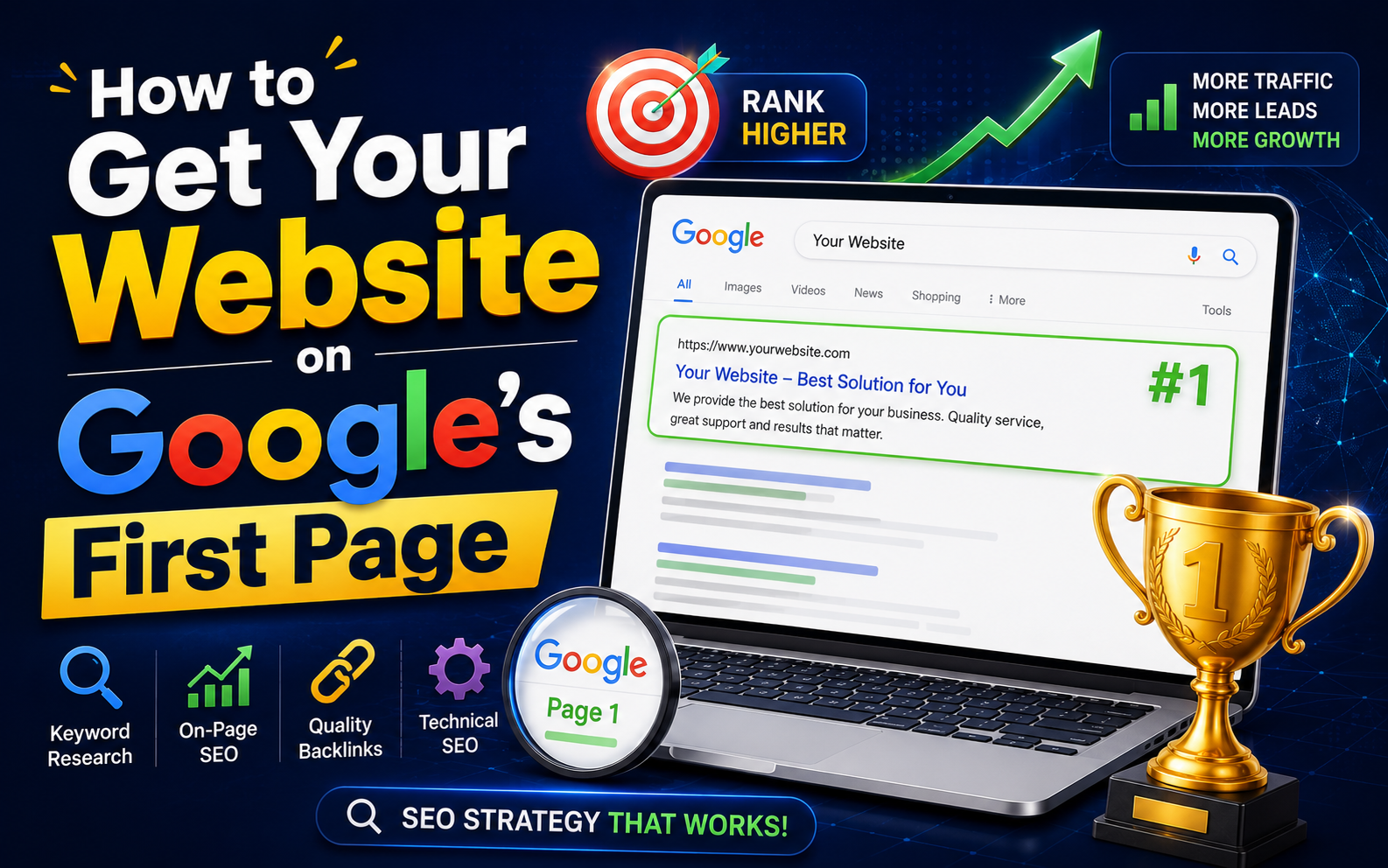
How to Get Your Website on Google’s First Page in 2026: The Complete Step-by-Step Guide
How to Get Your Website on Google’s First Page is the focus of this section, and here’s what matters most. Your site isn’t ranked and each day passes, which means you’re losing visitors, lost leads and profits going directly to your competition. The truth is that getting on the first page of Google in 2026 will be more challenging than it was a year ago, but it’s easier for smaller websites that are playing the right way. This guide will give you all the information you need to know with no nonsense and no ambiguous advice.
In order to get your website listed placed on Google’s first page takes the combination of good technical health, quality content that matches keywords, reputable links, and a great user experience. There’s no one trick or shortcut, but there’s a straightforward and repeatable method that is effective for companies of all sizes. The websites that make it to page one by 2026 are those that have a consistent record of relevancy to their customers, trustworthiness, and value to Google as well as real people. It also ties closely into How much does it cost to get your website first on Google?.
What “First Page” Actually Means in 2026
Before you get into strategies you should think about what you’re really competing for. The Google first page in 2026 isn’t the same as it was in the year 2019. Based on the question at that top part of the screen could be filled with the AI Overview — a created summary that addresses the query before displaying any traditional results. Below, you may see a featured snippet of text or a map of the local area, People Also Ask boxes as well as shopping results and video carousels — all of which are before an unidirectional blue link is displayed. This connects directly with How to rank on Google’s first page in 2026?.
It’s important to remember that your aim isn’t simply to rank 10th. Being in the top eight positions organically and also appearing within Google’s AI Overview and a featured excerpt gives you two or three positions on the identical page. In 2026, the most effective first-page strategy is a multi-format one Optimize for organic ranking and optimize your content so that it can be found from the Google’s AI systems. It also ties closely into Can you pay to be on the first page of Google?.
Understanding the larger context affects how you design your content, organize the pages you create, as well as even think about what “winning” means.
The Foundation: Get Your Technical SEO Right First
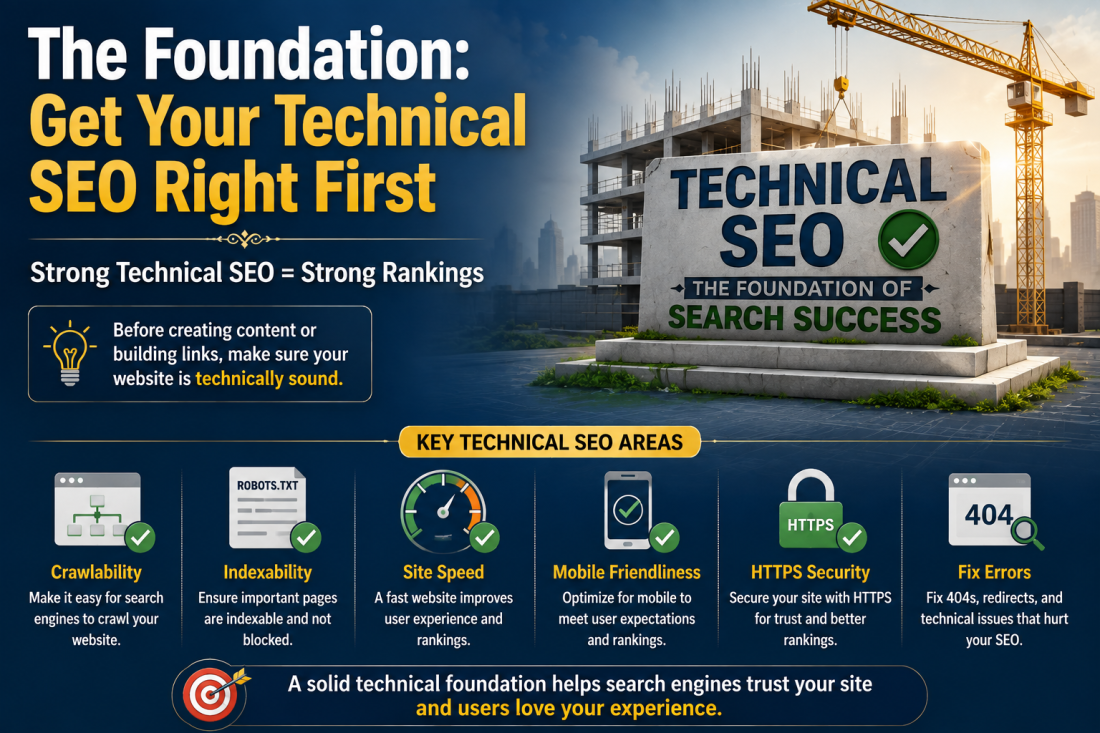
The best content will take you on the first page If Google cannot correctly crawl your website. Technical SEO may not be glamorous but it’s the basis that the rest of your site is built upon. It also ties closely into Can I do SEO by myself?.
Begin with Google Search Console. If you haven’t yet verified your website there take the time to do it nowIt’s free, authentic, and it’s the only tool that can show exactly what Google finds when it takes a look at your website. Check the report on coverage and review any pages that are marked as being in error or not included. Go through for errors or excluded pages. Check the Core web Vitals report to find out your website’s performance score. Go to for the Sitemaps section and upload an XML sitemap if you don’t have it yet.
Your site must be able to have a minimum level of technical proficiency before you can get rankings: 1.Ensure your pages are indexed. Type “site:yourdomain.com” into Google. If your pages aren’t able to show up, they’re not being indexed. Make use of Search Console to request indexing or determine what’s preventing them from appearing.
2. Fix crawl errors. Broken links (404 errors) or redirect chains and pages that are blocked through robots.txt are all a waste of crawl budget and ranking opportunities are lost.
3. Achieve passing Core Web Vitals scores. Google’s official thresholds are LCP less than 2.5 minutes, the INP below 200 milliseconds and CLS below 0.1. Check your score using PageSpeed Insights and fix the particular problems it flags.
4. Make your site mobile-first. Google indexes the mobile version of your website. If the mobile experience of your site isn’t great the ranking will reflect this regardless of how great the desktop version appears. This is especially relevant for readers researching How do I rank my website?.
Five. Use HTTPS. This has been proven to be a ranking signal since 2014. If your website is using HTTP Switch immediately.
6. Eliminate duplicate content. Use canonical tags to indicate to Google the version an article is the main one. The thin, duplicated pages diminish the authority of your website.
A quick, efficient, and properly indexable site won’t be an advantage in 2026. It’s merely the only requirement for competing even.
Keyword Research: Target What You Can Actually Win
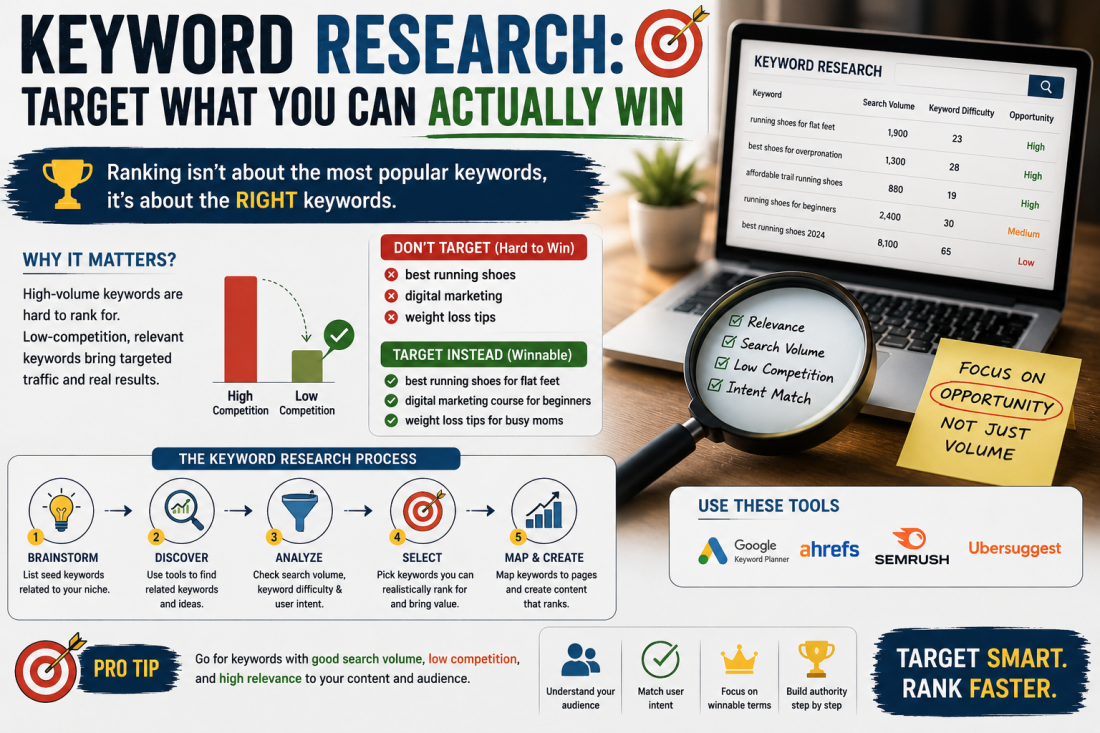
One of the main reasons why websites don’t make it to page one is because they’re focusing on keywords for which they aren’t likely to getting a win. A brand-new website trying to get a position on the search engines on the first page for “insurance” as well as “SEO” isn’t an effective strategyit’s just an illusion. This section also ties directly back to How to Get Your Website on Google’s First Page.
Effective search engine optimization in 2026 is that you find the connection between three elements which are: the keywords that real people look up and keywords that are relevant to your company and those where the competitive landscape provides real-world opportunities.
Utilize a tool such as Ahrefs, SEMrush, or even the free Google Keyword Planner to find keywords to think about. Take a look at the first-page results for these keywords. Consider: What kind of websites are they being ranked? If the top of the page is dominated by Wikipedia, WebMD, Forbes and ten-year-old domains with many backlinks then you’re going require a new perspective. This connects directly with How to get on Google First Page for free?.
Instead, search for variations with a long tail. Instead of focusing on “plumber,” target “emergency plumber in your city” for instance, or “how to clear the drain with no chemicals.” Instead of focusing on “SEO,” target “SEO suggestions on Shopify shops” as well as “how to rank a local service company with Google.” These more precise, longer words have less competition, clearer intentions, and better conversion rates.
The keyword difficulty metric used in the majority of tools ranks the competitiveness of a site on a scale of between 0 and 100. For sites that are newer you should focus on keywords in the 0-30 category to begin. Gain credibility through wins before moving on to more difficult terms as your site grows in trust.
One technique that is not used enough: examine the keywords your website is already ranking in the top positions between 4 and 15. These pages aren’t far. By making targeted changes in content quality including internal links, some additional backlinks, you can boost them up to the top of the list and significantly increase clicks without having to start from scratch.
On-Page SEO: How to Optimize Every Page
Once you’ve identified the best keywords, optimizing your on-page is the method of telling Google what the page is about and why it’s worthy to be ranked.
title tag: It is the one of the most vital elements on a page. Include your main keyword naturally, and limit it to 60 characters to ensure it doesn’t be cut off in the results of searches, and ensure that it is compelling enough so that someone will actually desire to click on it.
Meta Description It doesn’t have any direct impact on the rankings, but it directly impacts the rate of clicks. Write a paragraph of 120-155 words that summarises the page’s content and give an explanation of why you should click.
H1 Title: Each page should include only one H1 which has the primary keyword, or a similar variant. It should be clear and precise.
Content Structure Utilize H2 as well as H3 subheadings to structure your content in logical order. Google utilizes heading structure to comprehend the subject matter of a webpage. Subheadings help users scan and discover what they’re searching for, which increases engagement signals.
Keyword Use: Include your primary keyword in the initial 100 words. Use natural variations and similar terms throughout the entire document -not to increase denseness, but rather because a broad coverage of a subject naturally employs the language that people use to search for it.
Image Optimizing: compress images to ensure they won’t drag your site down. Include descriptive alt text which explains what the image is displayingThis aids Google comprehend the content you’ve created and meets users with accessibility needs at the same time.
Internal Links Links to other pages that are relevant with descriptive anchor text. Internal links help spread authority throughout your site and aid Google determine the relation between your content parts.
URL Structure Make URLs brief concise, descriptive, and keyword-inclusive. “yoursite.com/local-plumber-chicago” is better than “yoursite.com/page?id=4729.”
Content Quality: What Google’s Helpful Content System Is Really Looking For
The Google’s Helpful Content System has fundamentally altered the criteria used to be ranked. This isn’t a routine update, but an ongoing, global test that determines if the content was designed to assist people or was written to play ranking. Websites that don’t pass this test aren’t only being penalized, they also are able to see their entire domain snuffed out.
What exactly does “helpful content” actually mean in real life? Google’s documentation identifies websites that show firsthand experience and answer the question in full and are reliable, and leave the user with no reason to go back to Google and do a search. This last aspect is the most obvious sign of genuine value If someone has read your website and is satisfied it’s a good content.
Write from your personal experience whenever feasible. When writing on roofing repair, real-world insights gained obtained from doing or witnessing roofing repair are superior to generic data gathered by other web sites. Google’s quality evaluation experts are educated to spot the distinction. This also relates to What is Personal Blog.
Cover topics comprehensively. Don’t use padding or fillers however, with real depth. If a person searching for your keyword will naturally be interested in knowing three similar items, you should address those three aspects in your post rather than forcing them to to a different page.
The format must be in line with the purpose. A how-to query deserves numbered steps. A comparison query deserves a table. An “what does it mean” query should have clarity and an explanation. The way you format your content to be in line with what your user is actually looking for is a good signal.
E-E-A-T: Building Trust That Google Can Measure
E-E A-T — Experience, Expertise and Credibility, and AuthoritativenessGoogle’s method of testing the authenticity of websites and content which publish it. It is directly affecting how Google’s ranking algorithms are calibrated and trained.
Experience signifies that the writer has actually accomplished the task the article is about. First-person perspectives, specific details and unique insight that comes from experience can all be part of experience signals.
Expertise is possessing relevant credentials, knowledge or demonstrated competence in the field. Author bios that include qualifications, publications or industry recognition, as well as specific subject matter focus all serve as the credibility of your business.
The quality of your HTML0 is mostly earned through external recognition, which includes other reputable websites linking to your site or being mentioned in publications of the industry, and having a strong presence in your field. You cannot create this by yourself, but constructing backlinks and consistently publishing within a specific area of expertise builds the credibility over time.
The trustworthiness is the underlying principle of the four indicators. It is characterized by having precise information, accurate and reliable information, clear authorship, transparent editorial policies, functional links, current information, and no evidence of deceitful practices.
Actions to improve E-E-A -T on your site: include comprehensive author bios for every item of information, add an easy About page, include trust signals such as certificates or credentials, reference authoritative sources, and revise older material to ensure that it’s up-to-date. This also relates to How to Improve Your Blog.
Link Building: The Authority Signal That Still Matters Most
Backlinks are among the most powerful Google ranking signals through 2026. A backlink occurs when a website links to yourswhich is an endorsement of trust. There are many different kinds of votes A link from a reputable or relevant site has more weight than 100 links from directories that are not of high quality.
Building backlinks requires deliberate effort. The most efficient strategies include: Create content that is link-worthy. Original research, extensive guides, helpful software tools that are free, as well as data-driven research naturally draw links as they give other authors and journalists something to cite.
digital PR. Write expert commentary on the latest trends in the industry, and then pitch your article to the relevant publications. Make yourself available as a source for journalists that cover your topic through platforms such as Help a Reporter Out (HARO) or its 2026 counterparts.
guest posting. Write articles for credible websites in your industry that include a byline hyperlink to your website. Make sure you are writing for publications that your target readers actually read and not just any website which accepts guest articles.
Broken link construction. Use tools like Ahrefs to locate broken links on websites that are relevant to your business Then, contact the site to propose replacing the broken link with the link to your active and relevant content.
Analyzing competitor backlinks. Look at who links to your top competitors. Many of those sites will also link to excellent or superior content from you when you ask them to.
You should stay clear of purchasing links or exchanges for links or Private blog network (PBNs) as well as mass directory submissions. Google has advanced systems to identify links that are not natural, and these methods can lead to manual penalties that could effectively take your site off search results completely.
Local SEO: Getting on Page One for Your City or Region
If you provide services to customers in the same geographic region local SEO is the most effective way to get your site noticed on the first page. Local searches typically trigger maps which is a cluster consisting of local listings which appear on the right side of the page and a ranking there is usually easier than organically ranking, particularly for websites that are relatively new.
The most important aspect you can do to boost your Local SEO is to establish and improve you Google Business Profile. Complete every page with an complete address, name and phone number, as well as the business hours, website categories area of service and a complete description. Include pictures. Gather genuine customer reviews and reply to them. Update your website regularly. A well-optimized Google Business Profile with strong reviews will rank higher than those with a less than stellar one even if their website is more refined.
Check that your address, name and telephone address (NAP) are identical wherever they are displayed on the internet, including your website, Google Business Profile, Yelp, Apple Maps, industry directories, as well as anywhere else. Inconsistencies can confuse Google’s local entity match and reduce local ranking.
Create pages that are specific to your location on your website if provide services to multiple locations. A plumber from Chicago and also serving Evanston as well as Naperville should have distinct pages for each of the locations each with a distinct information pertaining to that particular arearather than a single common “service locations” page.
Optimizing for Google’s AI Overviews
AI Overviews have altered how you view the results page dramatically. Google’s AI synthesizes data from a variety of sources and provides a generated answer prior to organic results. The good news is that when Google’s AI is able to cite your content, your website name and link will be displayed in the upper right corner of your page. This is more likely to be a better use of space than the position one.
In order to maximize AI Overview citations, your page must be concise, clear and organized to address specific questions. Include your most concise answer to the query within only the initial 100 characters on your website. Utilize FAQ sections that provide clear comprehensive answers to commonly asked questions. Your content should be organized with clearly defined headings that correspond to the types of questions people are asked. Make use of simple, precise languageIt is important to use simple language. AI systems prefer content that is easily extracted and reorganized. This also relates to Types of Content Writing.
Schema markup is important in this case too. Schemas for FAQ, HowTo and Article schema assist Google to understand how your content, making the content more likely found for answers generated by AI.
Comparative: Organic SEO vs. Google Ads for First-Page Placement
Factor Organic SEO Google Ads Cost Time investment; cost of tools Pay-per-click; can scale quickly Time to achieve results 3-12 months are the norm.
As soon as the campaign launches Sustainability In the long-term, traffic continues to flow after efforts Stops when budgets stop The perception of trust More trust in clicks from users As ads, some users may not even click.
Scalability It grows with authority and quality content Budget grows with the growth Best for Brand authority, long-term growth Promotions, fast launches and high-competition terms Potential for ROI Very high in the long-term Based on margin and CPC Control Limited (Google algorithm dependent) Controlling the targeting process is extremely tight copy and budget For small-scale companies with limited funds The best advice is to spend the majority of effort into organic SEO and having a modest budget for ads to see the effectiveness of keywords before committing to the long-term creation of content around these keywords.
Expert Tips and Best Practices for 2026
Create authority on a topic not just for the individual web websites. Google rewards sites which cover a subject deeply and comprehensively. Instead of composing a single piece on “roof repair”,” create a hub that contains articles that cover different types of roofing repairs, repair and. replacement, cost-guides along with seasonal maintenance tips and comparisons of materials. Each article is a complement to the others and the whole hub signals the depth of expertise to Google. This also relates to 13 Types of Websites.
Make changes to your content prior to making new material. Refreshing a page which is already indexed and receiving some views is usually quicker than creating a brand new page completely from scratch. Update your statistics and add sections to increase the depth and then republish the page with the latest date.
Use Google Search Console weekly. Sort your queries by impressions descending. Look for keywords that get plenty of views but few clicks (your site is appearing, but isn’t causing users to take action). This is where enhancing your meta description can yield fast results.
Do not ignore interaction indications. While Google doesn’t explicitly declare engagement metrics as direct ranking factors, pages on which people spend longer and don’t immediately bounce, are more likely to rank higher. Create engaging introductions, organize the content for ease of scanning and fulfill the promise of your article.
Build internal links consistently. Every time you create a new piece of content, look back at previous relevant pages and then include a link to the new page. This increases authority and also helps Google to discover and index new content more quickly.
Be constant. The sites that get to page one and remain there are those that have an ongoing publication schedule with consistent quality and regular maintenance. Three quality articles per month that are consistently published over the course of a year is superior to ten articles published within a single month. Then, none.
Realistic Timeline: What to Expect Month by Month
The first Google page isn’t easy, and setting realistic expectations can help keep you focused instead of dropping a plan before it’s had the chance to get going.
Months 1 and 2 focus on foundations: technical configuration, Google Search Console configuration Keyword research, the initial creation of content. You might see a low traffic activity, but this is normal.
The months of three and four are the time when Google starts to build a picture of your website. If you’ve posted quality content and corrected problems with your website, then you’ll begin to see your impressions increase within Search Console even if clicks aren’t yet huge. Long-tail pages can begin appearing on pages 2 and 3.
The months between in the five- and six months are usually when the first major changes occur for keywords with lower competition. Pages you’ve built could be able to climb up to the top of the first page. This is also the time when the internal linking and updates to content begin to increase in importance.
The months of seven to twelve are when consistency results in a positive result. Websites that have solid technological foundations, expanding content libraries even a small link acquisitions regularly get multiple first-page rankings. Some terms that are competitive may require more time.
After 12 months If you’ve mastered this procedure and you’ve got a website that has established authority on the topic with a thriving backlink profile and a steady flow of organic traffic that is constantly growing and isn’t charged for each visit.
FAQ: How to Get Your Website on Google’s First Page
1. How long will it take to appear to the top of Google?
If you are launching a new website that targets keywords with moderate competition The realistic timeline is between six and twelve months of constant effort. Keywords with high competition in competitive sectors can take up to longer than two years. But, focusing on less competitive long-tail keywords can yield first-page results as quickly at two or four months particularly when you have a technical SEO that is strong and the content you publish is superior to the content currently ranked. The length of time depends on the competition of your field, your publication frequency, and the speed with which you establish backlinks. This connects directly with How can I get my website to rank on Google’s first page?.
2. How can I be placed to the top of Google for no cost?
Organic SEO is cost-free in that you don’t have to pay Google for its rankings. Yet, “free” doesn’t mean nothing at all — it takes time, effort and, often, investing in tools. There’s a good deal using free instruments: Google Search Console, Google Analytics 4, Google Keyword Planner and Google PageSpeed Insights are all available for free and cover the majority of the features paid tools provide. What paid tools such as Ahrefs and SEMrush provide to your business is data speed depth as well as competitive analyses that could greatly speed up the results. If you’re on a tight budget this free toolkit will be enough to get you started.
3. Do I need backlinks for my website to be ranked in the search engines?
For keywords that are truly competitive Yes, backlinks remain among the most crucial ranking indicators and it’s extremely difficult to rank on page one without these. For less competitive long-tail keywords, especially niche and local queries it is possible to get on the first page by using solid on-page SEO and great content by itself. If your keywords are more crowded is, the more crucial backlinks are. Begin by gaining rankable keywords by providing great content. Then, you can use these wins to establish authority that will aid your efforts to higher-level competition.
4. What is E.E.A.T and why is it important for ranking?
E-E A-T stands for Experience Expertise and Authoritativeness. Trustworthiness. Google’s framework for evaluating the quality of content. It’s important because Google’s ranking systems are partially on assessments by human quality evaluators which use these guidelines. Pages that demonstrate that the author’s experiences, relevant knowledge and credible credentials are likely to rank higher, particularly in the areas of finance, health legal, as well as other high-risk subjects (what Google calls YMYL – your Money and Your Life subjects). You can improve your E-E-A-T by composing thorough bios of your authors and citing reliable sources in your content, publishing up-to date and accurate content, and establishing an established reputation in your particular field.
5. What exactly are Core Web Vitals and do they impact rankings?
The Core Web Vitals are Google’s three measurement metrics of page experience which include Largest Contentful Paint (how quickly the main page loads) and Interaction with Next Paint (how fast the page responds to input from users) as well as the Cumulative Layout shift (how stable the layout of the page is during loading). They are verified ranking signals however they serve in a way that makes them more of a tiebreaker rather than an determining factor. pages with weak Core Web Vitals but excellent quality and credibility can outrank a faster page that has poor content. However, not meeting Core Web Vitals thresholds can hinder rankings for queries that are competitive and therefore it is a good idea to meet them as the primary goal. The goal is LCP below 2.5 minutes, the INP below 200ms and CLS below 0.1.
6. What do I need to know about the terms to target?
Begin with keywords that are closely connected to your product or service and then narrow them down using two criteria: volume of searches and difficulty of keywords. You should select keywords that users search for (even small monthly searches is acceptable) however, where competition is not so low that your site is able to beat the competition. Utilize free tools such as Google Keyword Planner or the free version of Ubersuggest as well as invest into Ahrefs or SEMrush to get more specific information about competition. Be sure to consider user intentMake sure that the intent of the keyword matches with the content of your website. A keyword that receives 200 monthly visits that completely matches your site is worth more than a keyword that has 2,000 searches, but you’re not able to match what people would like to see.
7. Is blogging still an effective method of getting your website on the top page on Google?
Yes however, only if you make it a strategic decision. Writing blog posts about random topics will not make a difference. What’s important is to develop specific content that is targeted to the specific keywords that your audience is searching for, using articles that are more comprehensive and useful than what is currently ranked. Each blog post gives you an chance to rank for a new keyword, increase your authority in the field, gain backlinks, and entice users at different points in their purchasing journey. The most important thing is quality over quantityA quality, well optimized post per week will outperform five rushed, thin posts.
8. How do I use Google’s Helpful Content System and how can it affect my site?
The Google’s Helpful Content System is a sitewide signal. This means that it assesses your entire site and not just the individual pages. It determines if your content was intended to aid users or primarily developed to rank on search engine results. Sites that produce large amounts of low-quality, search-engine-optimized-but-not-useful content can receive a sitewide suppression that reduces all their rankings, not just the bad pages. Recovering from an Helpful Content evaluation takes some time, even after having improved the content. The best way to avoid this is writing content that is able to answer the real needs of real people, written with real experiences and knowledge.
9. What is the impact of the Google’s AI Overview affect organic ranking traffic?
AI Overviews may cut down on the number of clicks on organic results for certain queries, since they answer the query directly on the page of results for search. Studies conducted between 2024 to 2025 revealed decreases in click-through rates for certain questions that are informational. However, AI Overviews provide a new avenue for growth: If your content is mentioned as an authoritative source, your website is listed at the highest of the list, with greater visibility than conventional ranking. The most effective strategy is to optimize your site for both writing content that is ranked organically and is clearly structured enough to be referenced in AI-generated responses. Sections for FAQs, straight response formatting and schema markup can all aid in the latter.
10. What is the reason my site is on the second page of Google and not on page one?
If you’re ranked at the top of page 2, you’re in a good positionyou’re found and indexed, but not competitive enough yet. The most commonly cited reasons why you’re on page two over page one include that your content may not match the intent of a search as compared to page one’s results or your site has less or lesser-quality backlinks compared to those on page one, or the page might have technical issues that slow it down or rendering it unusable for crawling or your Meta description and title tags isn’t persuasive enough to trigger the click-through rate signals that boost your rankings. Examine the page one results for your keywords and determine the specific benefits they provide the page you’re on. Make sure to close the gaps.
Topical authority is Google’s evaluation of how well and credible your site covers a specific topic. A site that provides 50 detailed articles on plumbing from a variety of anglesvarious types of pipes local regulations and DIY and. professionals, common issues, cost guidescreates authority on the topic of plumbing. Google starts to consider it as a reliable resource for plumbing-related questions. You establish authority on a topic through the creation of an “content hub” strategy: determine the most important topics within your field, and then develop content that addresses every relevant aspect of each subject. The objective is to have your site become the most comprehensive, reliable resource for your topic.
12. Should I make use of Google Ads while waiting for organic rankings to improve?
It’s dependent the budget you have set and your the timeframe you have set. Google Ads can put you at the top of the list in the instant for any keyword that you wish to bid on. This is helpful when you need leads right now and don’t want to be patient for six to 12 months to see organic results. However, the traffic will cease completely once your budget is exhausted, and, depending on the industry you operate in the cost-per-click could be so high that it makes advertisements not profitable. An effective strategy for small-sized companies is to employ the budget of a small ad to see which keywords actually perform for your company in the long run, and then design your organic strategy around those tested convertors. This means that your SEO efforts are focused on the keywords you know already bring in income. This is especially relevant for readers researching Is SEO dead now with AI?.
13. Is mobile optimization important to the first-page ranking 2026?
Importantly important. Google utilizes mobile-first indexing, that is, it crawls and indices that mobile-friendly version of your site to serve as your primary site. In the event that your mobile user experience isn’t great — slow, difficult to use, your text that is too narrow to comprehend, and buttons placed too close — this is the kind of thing Google evaluates when deciding which page to rank you. With over half of all searches taking place through mobile phones, a bad mobile experience also translates into low engagement which can further hinder rankings. Check your website’s performance on actual mobile devices using Google’s mobile-friendly test tools and make sure your site’s pages pass Core Web Vitals on mobile and desktop. This is a common question for anyone researching How to Get Your Website on Google’s First Page.
14. Does a brand-new website get a spot on Google’s top page?
It’s true, however it needs an approach that is more strategic than a well-established site. The new websites don’t have any prior domain experience or a backlink profile. Therefore, they must target less competitive keywords in which these advantages are less important. Concentrate on specific long-tail searches, create the content around topics that you’re competing on but haven’t covered fully and put a premium on technological excellence from the start. Certain industries have a lack of competition, even for terms with moderate traffic local service providers for instance, frequently notice that their newly launched website is able to get on the first page in a short time due to the fact that their competition isn’t properly optimized. Websites that are newer also benefit by fully making the Google Business Profile for local exposure. This is especially relevant for readers researching How do I get on the first page of a Google search?.
15. What are the most common errors that keep websites off on the top of search results?
The most frequent and damaging errors are using keywords that are too in competition for the website’s authority and publishing content that doesn’t answer the query of the searcher as well as ignoring technical SEO issues that block proper indexing, failing to build any backlinks (or creating poor quality ones) or experiencing poor mobile performance not optimizing meta descriptions and title tags and publishing content specifically for search engines instead of users and not making use of Google Search Console in order to detect problems and correct them and failing to be constant for a long period of time. Many sites that don’t rank aren’t doing just one wrong thing, they’re committing several minor mistakes at the same time that prevent them from achieving rankings in a competitive market.
Summary and Conclusion
Making it to Google’s first search page in 2026 is a complex challenge which rewards perseverance as well as strategic thinking and a genuine dedication to excellence. It’s not about discovering a loophole or growth hack, it’s about constantly providing the most effective answer to the questions that your visitors are asking.
The process begins with the technical health of speedy, easily crawlable properly-indexed and well-indexed website that is able to pass Core Web Vitals and works perfectly on mobile devices. Then, savvy keyword research can help you determine the most important battles to fightrelevant enough so that you’ll be able to win yet meaningful enough that winning them can bring qualified traffic.
Optimizing your pages on the page ensures that Google knows what every webpage is all about. Quality of content is real depth, real expertise clear and concise answers — pleases the Google’s Helpful Content evaluation and the people who actually read your webpages. E-E-A-T-signals build credibility to earn top-of-the-line placement in search results for competitors. Backlinks carry authority from established websites to your site. Local businesses can benefit from the fully optimised Google Business Profile opens a straight path to visibility on the first page which doesn’t mean waiting for weeks for rankings on organic search engines to develop.
In 2026, success on the first page will require thinking outside the blue link that is typically associated with first-page success. AI Overviews as well as featured snippets of content, as well as local map packs all constitute first-page real property. The way you structure your content for accessible by AI systems with clear and concise answers and FAQ formatting, as well as proper schema markup – offers you a variety of opportunities to show up in the upper right corner of the screen.
The time frame will be measured in terms of months and not in days. Every piece of content you improve each technical issue you resolve, and each quality backlink you get earns. Websites that adhere to this method do not stop at the first page, they remain there and they continue to grow after the initial investment has been repaid several times over. Begin by establishing your technical base today. Conduct your keyword research this week. Release your very first content that has been optimized in the month. Do it again the following month. This is how rankings on the first page are constructed.