What Is Personal Blog Meaning: 8 Types And Ideas Explained
Personal blogs are websites where an individual can publish their own opinions, experiences, expertise, and knowledge on any subject that interests them. Personal blogs are written in the first person, they’re managed by one author and they’re built on personal goals rather than commercial ones. Imagine it as an online diary that anyone can access, read and learn from.
This guide will tell you everything you need, from the history of blogging, which began in 1994, to the most popular personal blog types and how to create one that grows.
What is meaning of personal blog?
This phrase is broken down into two parts. Personal content is that which originates with a single individual. This could be their stories, opinions, skills or everyday life. Blog is the shortened version of “weblog”, which is an online journal or log that’s regularly updated with new entries.
You get a personal blog when you combine the two: it is a website that is regularly updated by an individual, who posts content based on his or her own experiences, interests, and expertise. It’s written in a conversational and direct voice.
Authorship and intention are what separate a personal blog form a news website, corporate blog or media publication. The author of a personal blog is one person. This voice does not represent a company or brand — it represents a person. The author chooses topics, establishes tone, decides on the publication schedule and owns each word.
There are blogs on every subject imaginable. A retired teacher could blog about the classroom strategies he or she developed over a thirty-year period. Home cooks might blog about their culinary experiments. Software developers might describe coding concepts that they wish had been explained clearly to them. The human voice is what connects them all.
Personal Blogging History: When and How it all began
Understanding the origins of personal blogs helps us to better understand what they are now.
The First Personal Website: Justin Hall created links.net, a personal website where he shared personal writings, daily thoughts, and links. Many historians of internet history consider this to be the first personal website, even though “blog” was not yet a word.
1997 – The Word “Weblog”, Coined by Jorn Bärger, the owner of Robot Wisdom’s site, was the first to coin the term “weblog”. It describes the practice in which users log interesting links they find while surfing the internet. Early internet users began to recognize the concept.
1999 – “Blog” enters the language: Peter Merholz shortens “weblog” into “blog” on his website peterme.com. Blogger was launched in 1999 as the first platform dedicated to allowing people to create personal websites without having to know how to code.
2003 – WordPress Changes Everything In 2003, WordPress was launched, making it easier than ever for anyone to create, design and manage their own personal blog. It provided non-technical authors with a professional publishing platform that gave them full control of their content.
From 2004 to 2010, Blogging became mainstream: Politicians began to influence news cycles. Millions of people have become familiar with personal finance blogs. Food bloggers have turned their recipes into careers. Blogging was no longer seen as just a hobby, but also as a form of legitimate media and an income source.
Today – Personal Blogs and the Creator Economy: The creator economy includes social media, newsletters, podcasts and video channels. Personal blogs are often the hub of content, the platform owned by the individual that connects to all other channels

what is meant by personal blog??
A personal blog is managed by individual and not by a group of multiple authors, it contains content that may be a mixture of text, videos, audio, and images.
To make it simpler for you, when an individual creates a blog using any online blogging platform and shares any kind of information relative to him on it then it is known as a personal blog.
You may notice that a person who runs a personal blog talks in a normal tone just like talking with friends, and family members to convey thoughts, emotions, or any information.
As above examine the Responsible person to post articles on a personal blog is an individual author only not a group of authors, all the activities on the blog are managed by the author(owner of the blog) and can even cover as many as topics.

Types of personal blogs
8 types of personal blogs (with real examples)
Personal blogs can cover a wide range of topics. Here are eight of the most popular types. Each is clearly defined with an example from real life so you can see what they look like in action.
1. Lifestyle Blog
A lifestyle blog can be a personal blog which covers the author’s daily life, covering multiple topics. These include home, fashion and wellness, relationships and personal values. Content reflects the author as a person, not just one particular interest.
Lifestyle blogs are often a mix of personal stories and practical advice. A blog post may describe a morning ritual, then transition to a recommendation of a skincare product and then link to the recipe that author prepared during that week. The author’s personality is what ties everything together.
Real Example: Cup of Jo is run by Joanna Goddard and covers parenting, beauty, food and design with a warm personal touch. It’s a popular example of a lifestyle blog that has been well executed.
Best for People who have a wide range of interests, prefer variety to specialization, and are more interested in building a following based on who they are than what they know.
2. Food Blog
A food blog can be a personal blog that focuses on cooking, ingredients, culture of food, or dining experiences. This format combines personal stories with recipes, photography and video.
Food blogging has a wide range of topics. One blogger might only blog about weeknight meals with five ingredients. One author might explore regional cuisines. Another might be reviewing restaurants in their own city. They all share a passion for food, expressed through their own personal experiences.
Real Example: Smitten Kitchen is often cited as a food blog model. It has detailed recipes, beautiful photographs, and a personal voice which makes the reader feel like he or she is cooking with a friend.
Best for those who: Love cooking, baking, history of food, dining, and sharing recipes with others.
3. Health and Wellness Blog
A health and wellbeing blog will focus on mental and physical well-being. It may also include fitness routines, mindfulness, and self care habits. Many of these blogs are written by individuals who document their own health journeys – weight loss, recovering from illness, training to run a race or managing stress.
This type of content is distinguished by its personal touch. The reader follows along because the author has a real-life experience that they can relate to.
Best suited for: People who have a real health or fitness program and want to share their experiences, learn from others, and encourage them in their goals.
4. Parenting Blog
A parenting blog will cover the challenges and joys that come with raising children. Topics include pregnancy, newborn care, toddler development, schooling transitions, teen relationship, and the emotional complexity that comes with parenthood.
The shared experience of parenting creates a sense of community. When a blogger is honest about parenting, readers often feel less alone and more understood.
Best suited for: Any parent who wants to connect and share their experiences with others.
5. Travel Blog
Travel blogs document the author’s journeys — the destinations, the routes, the cultural observations, the practical logistics and the personal reflections about what it is to travel the world. Travel blogs that are successful combine practical information (how to travel, where to stay and what costs to pay) with compelling storytelling to make readers feel as if they’re on the trip.
Real Example: Matt Kepnes’ Nomadic Matt is one of the best-known examples of a travel blog which grew from a budget travel journal to a media brand.
Best for: Frequent travellers, slow travelers and digital nomads who want to share and plan similar trips with others.
6. Blog on Self Improvement
Self-improvement blogs focus on topics such as productivity, goal-setting, habit formation and mindset. They also cover career development, financial discipline, financial discipline for women, and communication skills.
This category is for readers who are actively working to improve themselves. They’re looking for frameworks and strategies and want an honest account of what growth looks like.
Real Example: The Zen Habits blog, run by Leo Babauta has consistently been cited as being one of the influential blogs in the last two decades. It is based on one person’s thoughts and reflections about simplicity, mindfulness, intentional living, etc.
Best suited for: Anyone who has a real personal development practice and can write about what they’ve tried, what has worked, what didn’t, and what lessons they learned.
7. Blogs on Politics and Opinion
A political blog will cover news, politics, civic issues and the author’s opinion or analysis of current events. These blogs are written with a personal viewpoint and express the author’s opinion rather than trying to be neutral.
In the early 2000s political blogging was a major part of the media landscape. Blogs like Daily Kos or InstaPundit attracted huge audiences. Political blogs are still a great resource for readers who seek out analysis from an authority they respect.
Best for: People who have strong opinions on social and political issues and want to engage in serious discussion about current events.
8. Photo Blog
A photography blog displays the author’s work, along with explanations of techniques, gear, the creative process and the stories behind each image or project. Some photography blogs have a portfolio style, while others combine tutorials and personal narrative.
Best suited for: Photographers at any level of skill who want to share and document their creative progress, as well as connect with others who love visual storytelling.
8 Benefits of having personal blog
Why start a personal blog? 8 Genuine Benefits
These are real benefits. Personal bloggers have consistently reported these outcomes, which can all have real impacts on your career, abilities, and everyday life.
1. The place to develop and express your ideas
Clarity is achieved through writing. You learn what you really understand when you are forced to put something into words. You can develop your thoughts more fully in a personal blog than you could do in private notes. It also allows you to share these ideas with others who may disagree, agree or add to them.
2. Improve your writing skills with measurable improvements
The best way to improve your writing is by practicing consistently. Bloggers who have been publishing regularly for an entire year report a dramatic improvement in their ability to communicate clearly and efficiently — a skill which transfers directly into professional settings.
3. Create an online community around shared interests
You will begin to build a community of readers who feel connected to your writing when you consistently write about topics that are important to them. This is true not only for the content, but also to you personally. The comments sections, social sharing, and emails from readers can create a community over time.
4. Professional Networking with Like-Minded Individuals
You can meet other professionals, writers and creators in your field through blogging. This is something you wouldn’t be able to do with traditional networking. These connections can lead to collaborations and opportunities such as guest posts, invitations to speak, or career opportunities.
5. Establishing your expertise in your field
Regularly writing in depth about a topic deepens you own understanding, and signals to search engines and readers that you’re a serious student. Blogs have helped many people get jobs, book deals, and consulting contracts.
6. The Portfolio that Works Around the Clock
Your blog archives are a public record that reflects your abilities and thinking. It shows your thinking, and not only what you’ve done, unlike a resume. A strong personal blog can be more convincing to potential employers or clients than a traditional resume for writers, marketers and designers.
7. Develop Interconnected Digital Skills
A personal blog can teach you about search engine optimization (SEO), content strategy, social networking promotion, basic web development, email marketing and analytics interpretation. All of this is done in a low-stakes, practical environment, where you learn immediately and experiment for free.
8. Multi-channel revenue streams: Realizing the Potential of Multiple Revenue Sources
Bloggers can earn money through display advertising networks such as Mediavine and AdThrive. They also make money from affiliate marketing, sponsored content and digital products, like e-books, courses and eLearning, coaching and consulting services, or membership communities. Orbit Media’s blogging survey shows that bloggers who follow best practices and post regularly are more likely to have good results. It takes time for blogging income to grow, but the results are real and reproducible.
5 Tips to Build a Successful Personal Blogging Site
Tip 1 – Choose a niche and own it
Most new bloggers make the mistake of trying to cover everything. A blog focused on a single topic — such as productivity strategies for teachers or sourdough-baking for beginners — will grow more quickly and attract a larger audience than one that covers 20 unrelated topics.
Your niche doesn’t have to be impossible narrow. Your niche does not have to be incredibly narrow.
Tip 2: Understand the basics of keyword research
Search engines provide the most consistent and reliable source of traffic for blogs. Spend ten minutes before you publish your post researching the phrases that people use to search for information about your topic. This data is available for free through Google Keyword Planner and Google Search Console. If you are willing to invest, paid tools such as Ahrefs or SEMrush can provide a deeper analysis.
By writing posts based on real search queries, your content will be found by people rather than lingering in a corner of the web.
Making your blog visible on Google to let allow people to discover your content requires a deep understanding of keyword research and SEO.
Before publishing content ensures to perform some easy techniques of on-page SEO to let Google index your content and give some better ranking on SERP (search engine results page).
Free premium tools like ahref is best to get started analyzing keywords to write on.
Related guide: on page and off page SEO.
How to write your first blog post
How to choose a profitable niche for personal blogging
Tip 3- Writing as if you are talking to a specific person
Blogs that people enjoy reading are more like a conversation than a broadcast. Imagine a specific person – a friend or colleague who has asked you about the topic – and then write your post as though you were explaining it to that person. Use their language. Answer questions that they might ask. Avoid using jargon, unless it is explained.
The content produced by this approach is more engaging, and also more useful. These are two factors that encourage readers to return.
Tip 4: Consistently publish your content
Consistency is more important than frequency. A blog which publishes a well-researched and clearly written post once every two weeks is more likely to perform better than a blog which publishes five hastily written posts in one week, then nothing for six weeks. Put your schedule in a calendar and make sure you stick to it.
Reliability is key to building audience trust. Search engines reward sites with a more predictable publishing schedule by crawling them more consistently.
Tip 5: Use multiple channels to promote your content
It is only the beginning. Share your blog posts on social media platforms where you target readers are active. Repurpose your blog content as short posts for LinkedIn, Pinterest, Twitter threads or YouTube. Create an email list right away so that your new posts are seen by people who want to be contacted.
Blogs that are growing the fastest promote each piece of content, and not just publish it.
How do I start a personal blog?

It is not necessary to have technical knowledge in order to start a blog. This is a step-by-step guide.
Choose your niche first — the subject matter that your blog will be focused on. Second, select a blogging platform. WordPress.org is the most popular and flexible option. According to W3Techs, it powers over 43% all websites on the Internet.
Register a domain that reflects the focus of your blog or your name. Purchase web hosting through a reputable provider who offers WordPress installation and storage. Customer support should also be responsive.
Install a mobile-responsive, clean theme that is fast and responsive. Sixth, create your most important pages: Contact, About and Home. Write your first 10 posts before you launch so that readers will have plenty of content to explore.
Implement basic SEO settings with a plugin such as Yoast, Rank Math or other similar tools. Connect Google Analytics and Google Search Console from the beginning to track traffic and performance. Tenth, start promoting your content to readers and engage them.
Here how you can start straightaway
To build your personal blog you can opt for Hostinger which is one of the reliable and affordable services to get your blog live hassle-free.
Highly recommendable for Indian people who want to build a personal blog but are running on a tight budget.
Here is an exact step to get started quickly for 4 years at only 48$
Hostinger offers a wide range of hosting solutions from shared hosting to higher compatible plans that suits best based on your requirements.
First Visit Hostinger
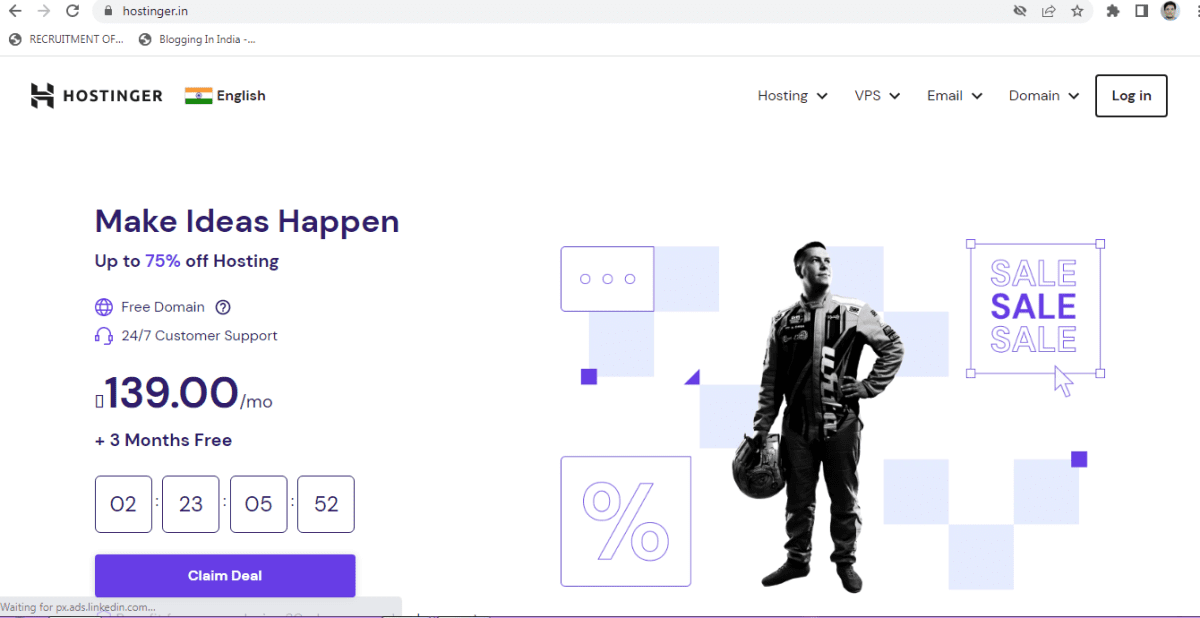
On Hostinger shared hosting you get various plans shown below.
Single web hosting: Allows you to get started quickly but for only 1 domain, which means will only be able to host 1 website, features included 50GB SSD Storage, unlimited free SSL, Free website builder, 24/7 support, 30-day money-back guarantee, you can visit their site to know what more they offer with this plan.
Premium web hosting: Planning to build multiple blogs?? this plan gonna be perfect for you, it allows you to host 100 websites on this plan and comes with incredible features
Business web hosting– Best for small and medium businesses, As more security and functions can be found in this hosting plan.
If you are going to begin a personal blog then there shared hosting plans is what you should opt for, the process is quite straightforward just select the plan as per your requirements, fill up your details and make a payment, that’s it.
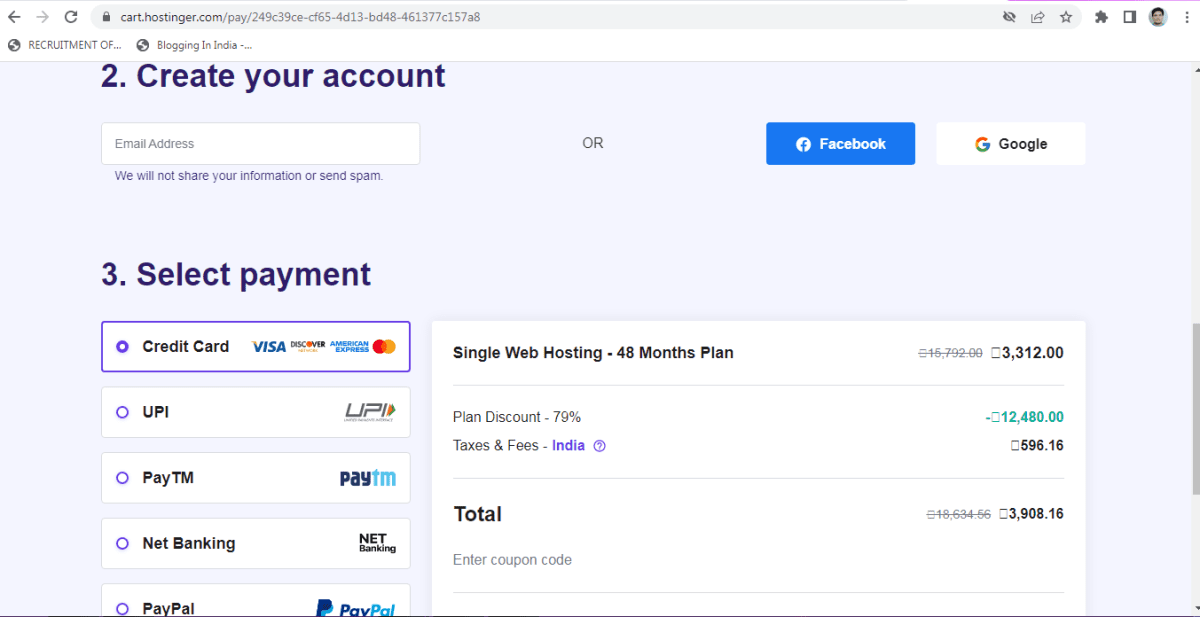
After making a purchase you can install Free WordPress software for designing and building your personal blog, that’s it.
If you want to learn the complete process from purchasing hosting to making your personal blog live using hostinger then must read my article on how to buy hosting from hostinger in 2023 and set up your blog.
Related guides: how to start a blog in India.
Personal blog Examples
Some popular personal blog examples.
This blog, run by Joshua Fields Millburn and Ryan Nicodemus, focuses on minimalism and simple living. The blog features articles, podcasts, and events related to minimalism and has a large number of following.
This blog, run by Brett & Kate McKay, covers a wide range of topics related to manliness, including self-improvement, relationships, and outdoor skills. The blog has a large following and has created a number of successful books and products.
This blog, run by Henrik Edberg, focuses on positive thinking and personal development. The blog contains articles, courses, and other resources related on how to live a positive and fulfilling life.
The owner of the blog, Marc and Angel Chernoff, covers a wide range of topics related to personal development and productivity. The blog has a large following and has spawned several successful books.
This blog, run by Leo Babauta, focuses on simplicity, mindfulness, and personal development. The blog is followed by large number of peoples and they has launched several successful books also.
Summary and Key Takeaways
A personal blog can be one of the most valuable and accessible things you can do online. This guide is a condensed version of the essentials.
Personal blogs are websites run by one author, who posts content that reflects their interests, expertise, and experiences. The personal voice and perspective of a personal blog sets it apart from media and business blogs.
In 1994, Justin Hall launched links.net. The term “blog” was first used in 1999. WordPress launched in 2003, democratizing the format. It also enabled the blogging age that has shaped the creator economy of today.
Eight of the most popular types of blogs are travel, photography, politics, self-improvement and parenting blogs. Each has its own audience and content expectations.
Eight primary benefits are: idea generation, improving writing, building a community, professional networking and expertise, creating a portfolio, developing digital skills, income generation, and creating a blog.
A successful personal blog is built on a niche-specific approach, keyword research, conversational style writing, regular publishing and active promotion through multiple channels.
It is not necessary to have any technical knowledge in order to start. All you need is a topic, a hosting platform that works, and a willingness write your first article before you are ready.
Starting a personal blog is one of the lowest-barrier, highest-potential investments you can make in yourself. Whether your goal is to develop a skill, build an audience, establish professional credibility, or eventually generate income, the best time to start is now — and the only real requirement is something genuine to say.
FAQ on what is personal blog
-
What is a personal blog, in simple terms?
Personal blogs are websites where an individual publishes regularly written content – posts, articles or journal entries – about topics that they care about, have knowledge of, or experience. The blog is written by a single author and reflects the author’s perspective, rather than representing an organization or brand.
-
How is a personal blog different from a business blog?
Personal blogs are written and owned by individuals and reflect their voice, interests and experiences. A business blog, which is usually written by several employees or by contracted writers, is created by an organization to achieve marketing, customer education or search visibility objectives. A business blog is written to serve the commercial interests of the company, while a personal blog is created for the creative, professional or personal goals of the author.
-
How is a personal blog different from a website?
A website is the general term used to describe any collection of web pages. Personal blogs are a type of website that is defined by its regularly updated posts, published in reverse chronological sequence, one primary author and content driven more by personal interests than by organizational purposes. Not all blogs are personal blogs, but they are all websites.
-
What is the difference between a blogger and a personal blog?
Bloggers are people who write and manage blogs. Personal blogs are the platforms on which they publish. It is important to make this distinction because Google’s free blog platform (blogger.com) also goes by the name “Blogger”. This can lead to confusion. A blogger can write on Blogger or publish on WordPress, Substack or other platforms. Bloggers are the ones who create the personal blog.
-
Can you make money from a personal blog?
Yes. Bloggers can earn money through a variety of channels, including display advertising networks, affiliate marketing, sponsored posts, digital products, such as e-books, templates and printables, consulting and coaching services, membership communities, and online courses. After 12-24 months of publishing consistently, monetization begins to produce meaningful income. However, timelines can vary depending on the niche, frequency of publishing and marketing strategy.
-
Is it possible to start a blog for personal use without spending any money?
Yes. WordPress.com and Blogger offer free plans to allow you publish a blog, without having to pay for hosting. The trade-off is that free plans typically display the platform’s branding in your URL (for example, yourname.wordpress.com rather than yourname.com), limit your ability to customize the design, and restrict monetization options. Bloggers who are serious about their blogs will eventually move to a self hosted solution, using WordPress.org and paid hosting. This gives them full control of the site.
-
What topics should I cover on my blog?
Write about anything you are interested in, know about, or actively learn. Most successful blogs are based on topics that the author is passionate about, not just topics that seem lucrative. Start with a hobby or skill you’ve been practicing for years. Or, talk about a profession or expertise that people ask you to share.
-
How frequently should I update my personal blog?
It is more important to be consistent than to be frequent. It is better to publish one post per week that is well researched and clearly written than five posts in a hurry one week, followed by nothing the next three. Most bloggers can maintain a realistic pace of one to two blog posts per week. It is important to pick a schedule that you can stick to, both to meet the expectations of your audience and to ensure search engines crawl patterns are met.
-
What is the average time it takes to build a blog?
Personal bloggers will begin to receive organic traffic between six and 12 months after their launch. This is assuming that they have been publishing regularly and using basic SEO. It takes 12-24 months to build a loyal audience and generate income. Orbit Media’s blogging survey shows that bloggers who actively promote, collaborate and publish long-form articles report better results than those who wait and publish passively.
-
How can a blog be successful?
Personal blogs that are successful and have a loyal audience over time tend to share certain characteristics. These include: a specific, clear focus on which a defined readership is interested; a distinct and authentic writing style; regular publishing; real value or entertainment for the reader; active marketing through email, social media and community engagements; and the willingness to improve in response the data.
-
Will blogging be relevant in 2026?
Yes. Although the distribution landscape is fragmented between social media, videos, podcasts, and newsletters; written blog content continues to be one of the most efficient formats for building audience, sharing knowledge, and long-form traffic. Blogs are a great option because they’re permanent — a post that is well-written today can generate traffic for many years — and the owner of the audience and platform, which means the author. Many creators use their personal blogs as a platform to build their presence across multiple channels.
-
What exactly is a blog niche and why does this matter?
Your blog’s niche is the topic or subject that you choose to focus on. A niche blog will build a loyal and targeted audience, as opposed to a blog which covers random topics. Search engines can also rank sites that are more focused because they understand the coherence of their topics. Your blog does not have to be limited to one article topic. However, it should have a theme that both readers and search engine can easily identify.
-
Am I required to have technical knowledge in order to create a blog for myself?
No. The latest blogging platforms, such as Squarespace and Wix, are designed to be used by non-technical people. It is possible to create, design and publish an attractive personal blog, without having to write a line of code. To get started, you only need a basic understanding of how to navigate a website’s dashboard. As your blog grows, technical skills such as custom CSS, plugin creation, and server administration become more useful, but are not required to get started.
-
Which is the best blogging platform for personal blogs?
WordPress.org is a self-hosted blogging platform that powers over 43% (according to W3Techs) of all websites. It offers the greatest control over SEO, design and monetization. Substack offers a great option for bloggers looking to combine their blog with a newsletter, without having to manage hosting. Ghost is a fast, clean alternative to WordPress. It has powerful writing tools. Blogger is free and a good option for beginners. Your budget, technical ability, and long-term objectives will determine the best platform for you.
-
What’s the difference between personal branding and a blog?
A personal blog is the format of regular posts published on a website. Personal brand is the reputation, expertise and identity that an individual develops across various channels. Personal branding is not just about a blog. It also includes social media presence, speaking engagements, networking and professional reputation. Consider the personal blog to be the base of a personal branding strategy.
-
How can I encourage people to visit my blog?
The traffic to a blog can come from several different sources. Once your posts are ranked for relevant search terms, it takes 6-12 months to achieve organic traffic. When you share your posts on social media, you can generate immediate referral traffic. Each new blog post brings back readers who have subscribed to your email newsletter. Guest postings on established blogs within your niche will introduce your writing to the audience of those blogs. Participating in genuine online communities around your topic — such as forums, comment sections and social groups — will help you build awareness and trust.